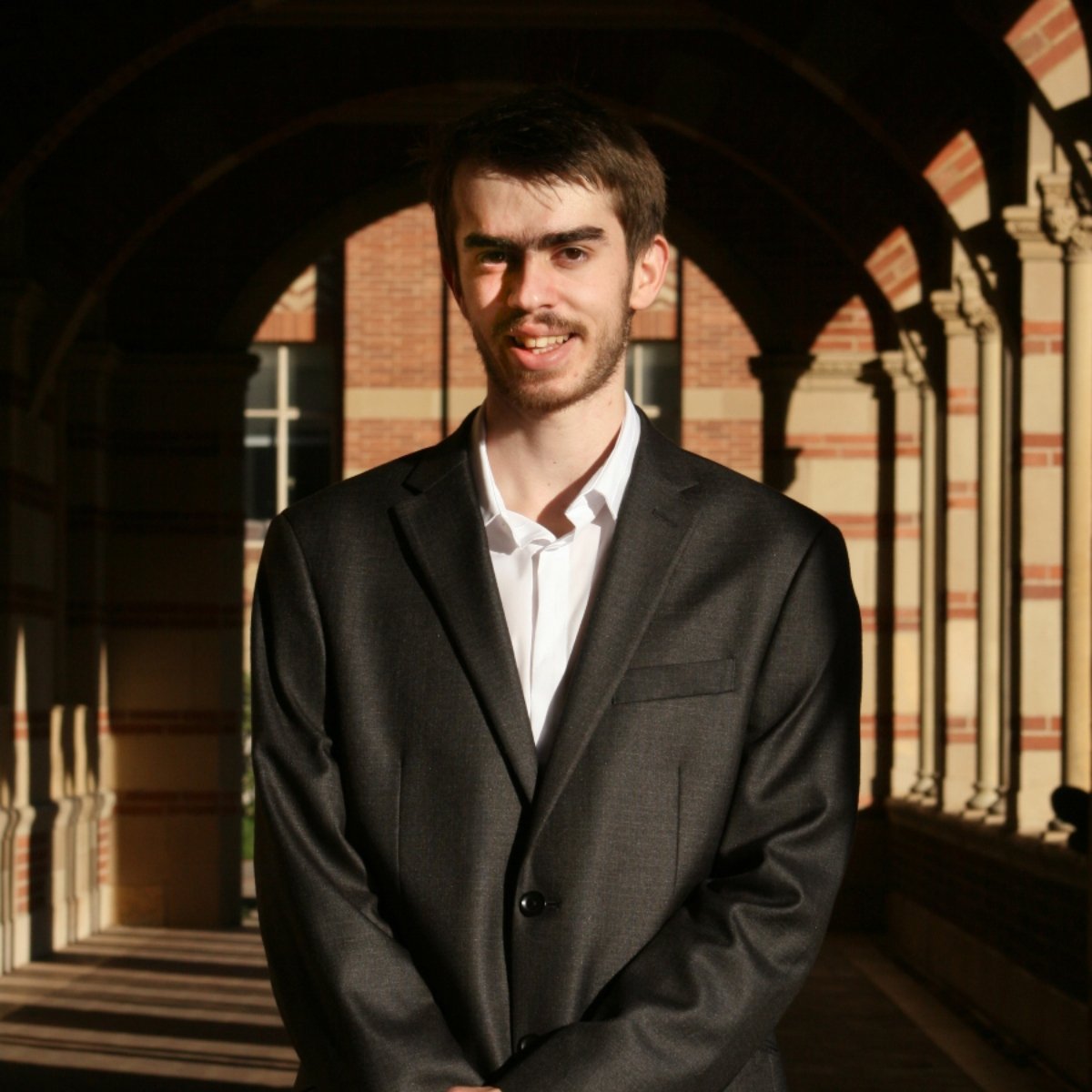
From Kenya to UCLA: The Journey and Insights of Statistician Samuel Onyancha Onyambu
It was spring quarter 2025, and I had just finished my final for Stats 13 (Introduction to Statistical Methods for Life and Health Sciences) at UCLA.
“Hey, that wasn’t too bad.”
I agreed with my girlfriend, “You’re right. Plus that professor was super nice. Maybe we should stay in contact with him after class?”
“Sure.”
Fourteen weeks later, we returned to his office on the roof of Boelter Hall. The khaki brown of the roof, the silvery fog of the September morning in Los Angeles, and the reflective, crisp dew enveloping the entirety of this seemingly secluded roof had precisely mirrored our thoughts: Who is this mysterious man with nearly no reviews on Bruinwalk, yet such a passion for teaching and this deep of a love for statistics?
“Hi Professor Onyambu, may we come in?”
“Yes, please… you can keep the door open,” he chuckled, as we tried to shut the door behind us. “Remind me, is it J and… E?”
Five months of weekly meetings later, I sat down with Dr. Onyancha Onyambu to talk stats, life, and learning, hoping to open a window for you into one of the most interesting, insightful, inspirational, and exciting journeys into STEM at UCLA.
Dr. Onyancha Onyambu was born and raised in a small town in Kenya called Muhoroni. His family was among the poorest in the town. Dr. Onyambu recalls going to class hungry and barefoot, staring silently at his peers while they ate lunch. Little by little, his mother started a small business, making enough money just to get by and to feed her children. It was this very poverty, this struggle in his youth to attend school and to focus on his studies rather than the ringing growl of his empty stomach that prompted a young, sixth-grade Dr. Onyambu to have a dream and to make that dream a reality.
“I set a goal that in 2014, I will be in America.”
This difficult, yet relatively peaceful existence was disrupted during the 2007–2008 Kenyan crisis. The intertribal violence following the botched presidential election in Kenya spilled over directly into Dr. Onyambu's hometown, forcing his family to flee to the nearby village of Ikonge.
“While we were running for our lives, we were in two vehicles, and my dad had to separate the family, so that if one dies, the other ones hopefully survive. He had already made that decision. So it was me and dad and mom in the front car, then my sisters and dad’s friends in the very back so that if at all we die, they survive, and we go in front.”
“Eventually, we got to a point whereby dad got conflicted. Should he go through town, or should he go through the village, the rural places? And then in his mind, he decided, we will go through the village, these rural places. The reason being, the fight has not yet gotten there. And even if it gets there, these people (the militias) are not expecting foreigners to be coming through this region. So we decided to go through these rural regions. And then the other, the friends, were like, ‘no, we will go through town.’”
“Their car ended up being burnt, the people ended up dying, all of them, they died. They were killed. But we survived.”
I asked him how old he was when this happened.
“Fifteen.”
With only one pair of clothes each, Dr. Onyambu and his family had to rebuild their lives in Ikonge, but he remained as determined as ever. After studying hard, he made it to one of the top universities in Kenya, Kenyatta University, where he studied statistics and programming. The goal he set in sixth grade had only consumed his life more and more as he worked towards completing his bachelor’s degree.
“I used to look up. I'd see the stars. It was around 8, 9 p.m., and I’d look at the planes and I was like, one day, very soon, I'll be on a plane to America.”
In 2016 (he had jokingly relayed to me that he had perhaps miscalculated by two years in sixth grade), that opportunity came: He was accepted to a master’s program in statistics at Cal State Fullerton. After completing his master’s degree, he was encouraged by his professors, who saw great potential in him, to apply to a PhD program in statistics at UCLA. He concluded with, “And by God's grace, I came to UCLA. I did my Ph.D. and here I am now, sitting in an office with you. Yeah, long story.”
I smiled at him.
He corrected himself, “Success story. That's a success story.”
Under the mentorship of Hongquan Xu of the statistics and data science department at UCLA, Dr. Onyambu Onyancha completed his doctoral studies in design of experiments and hyperparameter optimization. Dr. Onyambu remains in this field where he hopes that his work can be used in fields such as medicine and chemistry. When I asked him to break down his work for someone unfamiliar with this field, he explained it as such: “I create algorithms that will enable the optimization process to be more efficient and faster with regard to constructing new designs that can be used in various applied fields.”
Although he has yet to make a major breakthrough in his research, he has empirical evidence demonstrating the success of his algorithms and broader work. Due to the applied nature of his work, the greatest challenge for him is creating the theoretical framework to support his discoveries. Still he anticipates to complete his current research and to apply for publication this year.
Despite his research being particularly pertinent to the development of AI systems among many other rapidly developing fields, Dr. Onyambu Onyancha is best known at UCLA as Professor Onyambu. Thus, I naturally asked what led him to pursue a career in teaching.
“I am curious about everything.”
“Tell me more.”
“When I came to the U.S., I didn’t just engage in statistical investigation; I couldn’t resist asking, ‘Why?’”
“Why are the license plates for cars this way?” “Why are the freeways numbered the way they are?” “Why are telephone numbers not starting with one or two?” “Why… why… why…”
These inquiries naturally carried into his field of study, where he began to find himself breaking down complicated concepts with simple solutions for his peers.
“But why did you begin to teach undergraduate students?”
“Because I saw that I could get the same solution as their professors but take an easier route. Why make something easy so hard for new learners to understand? And so, I made it my goal to just break down undergraduate-level statistics for students who also like to ask ‘why?’”
It seems to me that Dr. Onyambu Onyancha is a professor who is truly a leader in the dynamic landscape of academia today. From AI explaining the same concepts professors can in a drastically simpler manner to shortened attention spans and the ever-growing depth and complexity of nearly every field of study, learning is fundamentally changing. As he conveyed time and again to me, Professor Onyambu’s ultimate goal is that every one of his students takes the knowledge from his classes and applies it to their future studies and careers.
“Even though we all start with different tools and your socioeconomic background might impact you, I want to level the playing field in my classes.” As an internally displaced person and as an immigrant who had to build his life from scratch not only once but twice, Professor Onyambu believes that differences in class, race, and opportunity not only impact his students in class, but that these differences “cut across everything in life.”
“It is one of my hardest, but also my most important task as a professor: to level the playing field.”
“How do you do it?”
“On an individual basis. It doesn’t matter if I have ten or five hundred students in my lecture. My office is open for everyone, and my email and Campuswire never close.”
We laughed.
“It’s true,” I chuckled. “I remember you answered one of my last-minute, pre-exam Campuswire questions at 3 a.m. the night before the exam.”
“Of course, my students are my priority. My research may have deadlines, but my students are often only undergraduates once in their lives. I want them to learn.”
Our time was running out, but as always, I am compelled to ask everyone I interview to give one piece of advice to you, the reader.
“Learn.”
He paused for some time.
“Love what you learn. Make your profession your hobby.”
I knew he wasn’t done: he was too quiet as we walked out of his office and crossed the roof of Boelter Hall into the planetarium and onto the 8th floor of the Mathematical Sciences building.
As we said our goodbyes, he added, “And for that article you’re writing, the best thing here is family. It’s painful, I’m disconnected with my family due to distance right now. So tell them to keep family, whether chosen or biological, close to them and to their hearts.”
For more information about Dr. Onyambu Onyancha, please visit Dr. Onyambu | UCLA Statistics & Data Science, Dr. Onyambu | LinkedIn, Dr. Onyambu | Dissertation